

Have you ever looked up at an aircraft cruising overhead and thought, “I want to be the one in the cockpit?” Turning the dream of becoming a professional pilot into reality requires more than just passion; it starts with successfully navigating the flight school admissions process.
Whether you are aiming to enroll in the comprehensive 15-month Airline Pilot Pathway Program (APP) or starting your journey with a Private Pilot License (PPL) at Alpha Aviation Group (AAG) Indonesia, thorough preparation is your greatest asset. This comprehensive guide breaks down exactly what prospective students need to prepare, gather, and anticipate long before day one of training at our Batam campus.
To get you cleared for takeoff, we will cover the crucial flight school age requirements, the strict DGCA medical fitness standards, your essential educational prerequisites, and the exact step-by-step application process.
By the end of this guide, you will be fully equipped to tackle several points:
1. your psychological profiling;
2. aptitude tests; and
3. final interviews with complete confidence.
But before you can start compiling your admission paperwork, your journey to the flight deck begins by understanding the foundational eligibility criteria required to even enter the training environment.
Decoding Flight School Age Requirements
One of the most common questions prospective cadets ask the AAG Indonesia admissions team is, “Am I the right age to start flight school?” The short answer is that while you can technically sit in an aircraft and begin taking basic flying lessons at almost any age to build familiarity, the journey to becoming a licensed professional pilot is governed by strict legal milestones. Aviation authorities, including Indonesia’s Directorate General of Civil Aviation (DGCA), enforce specific age minimums to ensure that candidates possess the necessary maturity, cognitive development, and decision-making capabilities for each phase of flight.
The first truly monumental milestone in any aviator’s career is the solo flight. That is the day your Certified Flight Instructor steps out of the aircraft and you take the controls of an AAG Cessna 172 completely on your own. To legally operate a powered aircraft solo, a student pilot must be at least 16 years old. This milestone represents a massive leap in responsibility, proving that the cadet can safely manage the aircraft’s systems and navigate active airspace without immediate supervision.
Following the successful completion of true solo flights and comprehensive cross-country training, the next step is earning your Private Pilot License (PPL). The legal minimum age to be issued a DGCA PPL is 17 years old. Because this is the foundational license required to progress to all subsequent commercial training, AAG Indonesia firmly sets 17 as the minimum age requirement for admission into our programs. This ensures that from day one at our Batam campus, our cadets are legally positioned to hit their licensing targets without regulatory delays.
As cadets transition from recreational flying to professional aviation, the regulatory requirements scale up. To obtain a Commercial Pilot License (CPL) which is the certification that legally permits you to fly for compensation or hire, you must be at least 18 years old. For students enrolled in AAG Indonesia’s intensive 15-month Airline Pilot Pathway Program (APP), this timeline syncs flawlessly; by the time they have mastered their foundational flying and are ready for their advanced CPL and Instrument Rating (IR) checkrides, they have naturally reached the required legal age.
At the absolute peak of the civilian aviation ladder sits the Airline Transport Pilot License Theory (ATPL), the ultimate qualification required to act as a Captain for scheduled commercial airline services and large multi-crew operations. Due to the immense experience and heavy responsibility this role demands, the minimum age to hold a full ATPL is 21 years old.
While AAG cadets graduate with their “frozen” ATPL already completed, they will continue building the flight experience required for the issuance of a full ATPL. This experience may be accumulated through a variety of professional flying roles, including airline, charter, corporate, cargo, or flight instruction operations, before meeting the regulatory requirements for higher command responsibilities
Finally, it is time to debunk the pervasive myth of the “flight school age limit.” Many professionals considering a career change worry they have missed their window, but there is absolutely no maximum age to enroll in flight school or learn how to fly.
While major commercial airlines do enforce a mandatory retirement age for their airline captains (typically 65 years old), older individuals can confidently pursue flight training to become corporate charter pilots, flight instructors, or simply fly for personal travel. With these age milestones now clearly mapped out, the next critical step is ensuring you meet the physical standards required to enter the cockpit.
Before you invest significant time and financial resources into flight school, you must ensure that you are legally and physically fit to fly. The dynamic aviation environment places unique physiological demands on the human body, making a stringent health assessment an absolute non-negotiable. Securing your Aviation Medical Certificate is a critical early step that proves to the Directorate General of Civil Aviation (DGCA) that you can safely and reliably operate an aircraft, both in routine flights and under pressure.
It is important to understand the different levels of medical certification required for pilots. For student pilots beginning their flight training, a DGCA Medical Certificate is generally sufficient for initial flight operations.
However, cadets pursuing a professional aviation career will eventually need to obtain and maintain a DGCA Medical Certificate as they progress toward their Commercial Pilot License (CPL). Understanding these requirements early helps aspiring airline pilots stay on track for their long-term career goals.
In the Indonesian context, obtaining this certification involves a highly regulated, standardized process. You cannot simply visit your local family doctor. Cadet candidates must undergo their medical examinations at specific DGCA-approved aviation medical facilities.
The primary and most prominent institution for this is the Balai Kesehatan Penerbangan (Balai Hatpen), or the DGCA Pilot Health Center, located in Kemayoran, Jakarta. Because securing an appointment is mandatory for your AAG admission dossier, we highly recommend scheduling your visit well in advance of your desired intake date. You are also able to contact the AAG representative at Jakarta, to help and guide you for this kind of purpose.

Proper preparation for your exam day can save you from unnecessary stress, repeat visits, or administrative delays. On the morning of your assessment, it is heavily advised to skip your usual cup of coffee, tea, or any energy drinks. These common stimulants can artificially spike your heart rate and blood pressure, potentially leading to erroneous readings and unnecessary follow-up testing.
Additionally, ensure you arrive fully prepared with all essential items: your original National ID (KTP), your passport, any relevant past medical records, and your current glasses or contact lenses if you require them.
The assessment itself is a comprehensive, full-body evaluation designed to ensure peak operational readiness. You will be guided through:
- Battery of stations that include a thorough eye exam (testing both distance acuity and color blindness)
- Audiometry to ensure your hearing is sharp enough for radio communications
- An electrocardiogram (ECG) to monitor cardiovascular health
- Standard blood and urine analysis, and a general physical consultation.
While this rigorous checklist may sound intimidating, healthy individuals typically progress through the stations smoothly with the supportive guidance of the aviation medical examiners.
Once you successfully pass and the doctor issues your certificate, take a moment to meticulously verify that the spelling of your name matches your Identity Card/KTP exactly, as even a minor typo can cause major regulatory headaches prior to your final DGCA checkrides.
Furthermore, do not panic if you don’t possess perfect 20/20 uncorrected vision; many successful commercial pilots fly daily with glasses, provided their vision is correctable to the required DGCA standards.
With your physical fitness officially validated and your medical certificate securely tucked into your flight bag, your focus must now shift toward proving your academic readiness and gathering the required legal documentation.
Educational and Legal Prerequisites
With your DGCA medical certificate securely in hand, the next phase of your preparation involves proving your intellectual and legal readiness for the flight deck. Operating a commercial aircraft is a highly technical profession that requires a solid academic foundation, flawless communication skills, and an irreproachable legal background.
AAG Indonesia maintains strict standards in these areas to ensure that every cadet who enters our Batam campus is fully capable of managing the intense rigors of our flight training syllabi.
When it comes to your academic background, a common misconception is that you need a four-year university degree to become an airline pilot. While a college degree can certainly be an asset later in your career, it is not a strict prerequisite for flight school admissions.
The standard baseline to enter AAG Indonesia’s programs, whether for a Private Pilot License (PPL) or the comprehensive Airline Pilot Pathway (APP), is a standard high school (SMA) or its equivalent. This allows highly motivated students to begin their commercial aviation careers immediately after completing their secondary education.
However, because aviation is fundamentally rooted in science, your high school track does matter. AAG Indonesia evaluates your fundamental understanding of the core subjects that dictate flight: mathematics and physics.
If you graduated from a science-focused high school program, you already possess the necessary baseline. If you are applying from a non-science high school background, there is no need to worry. You will simply be required to pass basic Math and Physics assessments during your admission process to ensure you can easily grasp complex topics like aerodynamics, weight and balance, and aerial navigation.
Moving beyond mathematics, there is one subject where absolute fluency is completely non-negotiable: the English language. English is the universally mandated international language of aviation.
Whether you are reading highly technical aircraft operating manuals, coordinating complex maneuvers with your First Officer, or communicating with Air Traffic Control (ATC) at Hang Nadim International Airport, you must be able to fluently read, speak, write, and comprehend English without hesitation.
To verify this vital skill, AAG Indonesia requires documented proof of your English proficiency prior to your first day of ground school. Cadet applicants are required to submit a valid TOEIC test result, specifically focusing on Listening and Reading, with a minimum required score.
Alternatively, candidates who have graduated from an English-speaking high school or hold similar, internationally recognized proficiency certifications may use those to fulfill this critical requirement.
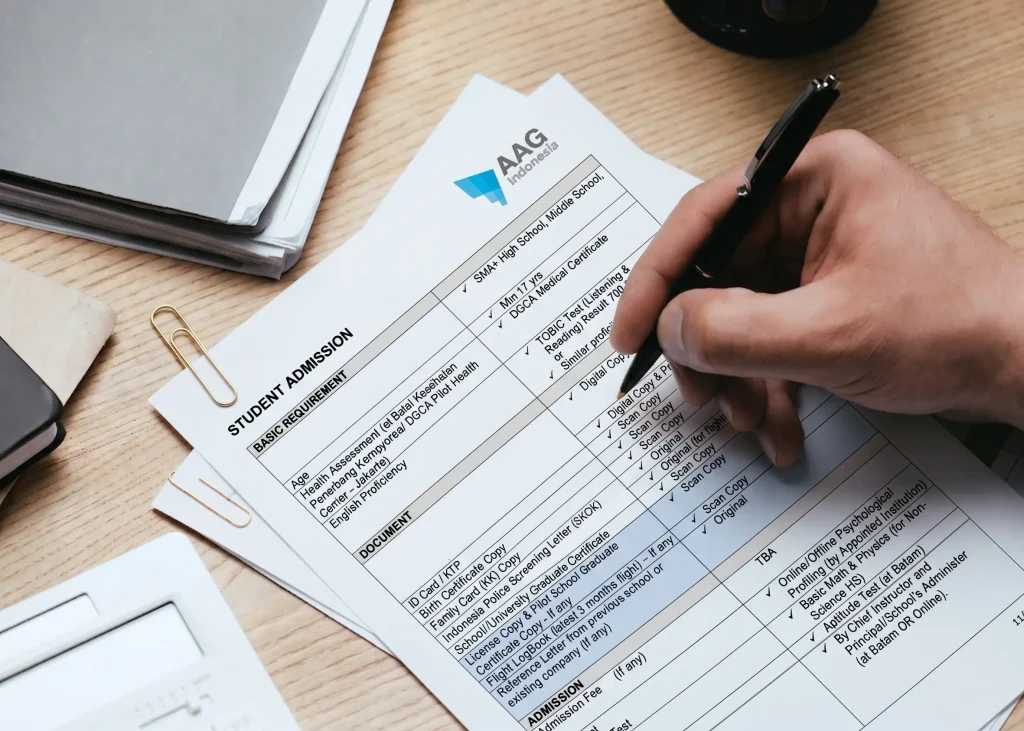
The Step-by-Step Admissions Process
Now that you deeply understand the age limits, the rigorous DGCA medical standards, and the educational prerequisites, it is time to actively navigate the admissions pipeline. Step one of this journey involves thorough research and discovery, which begins by understanding the different types of flight training environments available to you.
Globally, aviation authorities distinguish between highly structured, syllabus-driven academies (often referred to as Part 141 schools in the United States) and more flexible, independent flight training operations (known as Part 61).
In the Indonesian context, if your ultimate goal is to pilot a commercial airliner, enrolling in a DGCA approved Approved Training Organization (ATO) like AAG is the best option. Highly structured programs, such as APP, are meticulously designed to meet the strict competency standards demanded by major airlines. This structured route offers a streamlined, predictable timeline compared to piecing together individual licenses at a local flying club.
Enroll to Flight Discovery (Optional)
Before you sign any enrollment agreements, we highly recommend scheduling a Flight Discovery or booking an in-depth consultation and campus tour with our Batam admissions team.
This initial exposure allows you to sit in the cockpit of a Cessna 172 or our Redbird MCX simulator, physically feel the flight controls, and genuinely confirm your aptitude and passion for aviation. It is a thrilling, low-stress way to ensure that the realities of flight training perfectly align with your career dreams.
Once you have confirmed your commitment to the skies, step two requires actively compiling your formal application dossier. As we covered in the previous sections, this is exactly where your early preparation pays massive dividends.
Requirement Documents
You will need to bring together your DGCA Medical Certificate, your proof of English proficiency, and your legal clearances into one comprehensive submission package for the AAG admissions office.
Administratively, AAG Indonesia requires clear, digital, and printed copies of your foundational identity documents to process your student file. This checklist includes your National ID Card (KTP), a valid Passport, your Family Card (KK), and your Birth Certificate. For strict national security purposes, you must also include your recent Indonesian Police Screening Letter (SKCK).
Academically, your application must be built on a solid, verifiable foundation. You are required to submit your High School (SMA) or University graduation certificates alongside your official, certified transcripts. These documents verify your baseline educational readiness to tackle the intense theoretical demands of ground school.
Equally critical to your academic portfolio is your documented proof of English proficiency, as English serves as the undisputed global language of aviation. To validate the communication skills required for reading technical aircraft manuals and communicating effectively with Air Traffic Control, AAG requires applicants to submit a valid TOEIC test result with a minimum score of 700, or an equivalent English proficiency qualification recognized by the academy.
Furthermore, AAG Indonesia recognizes that prospective cadets come to us from varying stages in their aviation journeys. If you already hold previous flight hours or have earned a Private Pilot License (PPL) from another institution, submitting a clear scan of your official flight logbook at this stage is a crucial step. This allows our instructors to properly evaluate your existing experience and ensure you are placed on the most efficient training track.
Once your complete dossier of academic, linguistic, and experiential documents is submitted and verified, it officially triggers the formal assessment phase of your admission. This rigorous phase kicks off with a comprehensive online psychological profiling session conducted by a specially appointed institution, designed to evaluate your baseline decision-making skills, stress management, and potential for Crew Resource Management (CRM).
Psychology and Science Assesment
Following the psychological evaluation, candidates must prove cognitive readiness through a Basic Math and Physics assessment. Because aviation is a science-driven profession, this test ensures all prospective cadets especially those coming from non-science high school backgrounds.
The analytical skills required to grasp complex subjects like aerodynamics, navigation, and weight-and-balance calculations. The final and most defining stage of the admission process brings you directly to AAG Indonesia’s Mega Techno City headquarters in Batam. Here, you will tackle an aviation-specific aptitude test measuring your spatial awareness and hand-eye coordination.
Face to Face Interviews
The technical assessments and aptitude tests culminate in the most critical and personal stage of the entire admissions process: a formal, face-to-face interview (through offline or online) with AAG’s Chief Instructor, Raymond DuQuesnay and the Academy Principal, Karin Item. Hosted at our Mega Techno City headquarters in Batam, this capstone interview is your definitive moment to shine beyond the paperwork.
While your high school transcripts, TOEIC scores, and DGCA medical certificates prove that you are legally and intellectually capable of learning to fly, they do not tell the whole story. AAG needs to find the cadets mental and internal motivation. This is your opportunity to step out from behind your application documents and showcase the human element behind the test scores.
During this comprehensive evaluation, the leadership team is looking for the intangible qualities that define a true aviator. They are meticulously assessing your professional demeanor, your communication skills, and the inherent maturity expected of a future captain.
Flying a multi-million-dollar aircraft requires more than just sharp hand-eye coordination. It demands a safety-first mindset, calm decision-making under pressure, and an unwavering respect for aviation regulations. The panel wants to see that you carry yourself with the discipline and integrity necessary to command a commercial flight deck.
Furthermore, the Principal and Chief Instructor will rigorously examine your genuine passion for aviation and your personal resilience. Programs like AAG Indonesia’s comprehensive 15-month Airline Pilot Pathway (APP) are incredibly demanding.
You will face long hours of ground school study, complex early-morning simulator sessions in the Redbird MCX, and the intense pressure of continual DGCA checkrides. The interviewers will ask probing questions to understand your core motivations, how you handle setbacks or failures, and whether you possess the grit required to commit to this accelerated, highly structured training timeline without faltering.
Ultimately, you must approach this interview by shifting your perspective: the AAG leadership team is not simply looking for another student to fill a classroom seat because we are actively evaluating a future industry colleague. With the Southeast Asian aviation market experiencing unprecedented growth, our goal is to graduate pilots who will seamlessly transition into the right seat of major regional airlines.
By presenting yourself as a highly motivated, articulate, and dedicated candidate, you assure the leadership that you are fully prepared to uphold AAG’s prestigious reputation and thrive in a dynamic commercial aviation career.
Proof of Funding
Upon successfully passing the interviews and aptitude tests, you will reach step three: proving your financial readiness. Flight training is a significant, high-yield financial investment, and proving that you have the robust resources required to complete the program is a mandatory component of the final enrollment agreement.
Flight schools need absolute certainty that your training will not be abruptly halted midway due to a lack of funds. Whether you are self-sponsored, supported by your parents, or backed by a corporate entity, you must present a concrete financial plan.
Cadets often leverage strategic options to cover their tuition, ranging from hunting down localized aviation scholarships and highly competitive airline sponsorships to securing dedicated educational bank loans.
Presenting your proof of funding, such as official bank statements from the last three months or a formal corporate sponsorship letter is the final administrative hurdle before your seat is secured. By structuring this financial support early, you ensure that your focus remains entirely on mastering your flight maneuvers rather than stressing over tuition installments.
With your DGCA medical clearance in hand, your academic and legal documents verified, your aptitude proven, and your financial strategy securely locked in place, you are now standing on the very threshold of your professional aviation career.
Conclusion: Your First Checkride Begins Here
Reflecting on this comprehensive guide, gaining admission to a premier aviation academy like AAG Indonesia is a highly methodical and rewarding process. As we have explored throughout these sections, your journey to the flight deck begins long before you ever touch the yoke of an aircraft.
Here’s the summary of the step by step AAG Indonesia flight student admission process
Step 1: Research and the Discovery Flight Before committing to a rigorous, full-time aviation program, aspiring cadets are highly encouraged to schedule a “Discovery Flight” or an in-depth consultation with our Batam admissions team.
Step 2: Compiling Your Applicant Dossier Once you have confirmed your chosen pathway (such as our highly structured, DGCA-approved 18-month APP program), you must compile your essential paperwork. AAG Indonesia requires clear digital and printed copies of your foundational documents:
- National ID Card (KTP) and valid Passport
- Family Card (KK) and Birth Certificate
- DGCA Medical Certificate
- High School (SMA) or University graduation certificates and transcripts
- Valid TOEIC test result (minimum score of 700 for general admission)
- Indonesian Police Screening Letter (SKCK)
Note: If you already hold previous flight hours or a PPL, submit a scan of your license and your flight logbook for proper placement.
Step 3: Assessments and Interviews Submitting your complete dossier and admission fee triggers the formal evaluation phase. You will undergo:
- Psychological Profiling: An online evaluation of your decision-making skills, stress management, and potential for Crew Resource Management (CRM).
- Academic Assessment: A Basic Math and Physics test (particularly for non-science graduates) to ensure you can grasp aerodynamics and navigation.
- Aptitude Test: Conducted at our Mega Techno City campus in Batam to measure spatial awareness and hand-eye coordination.
- The Capstone Interview: A face-to-face (or online) interview with AAG’s Chief Instructor and the Academy Principal. They will evaluate your professional demeanor, communication skills, and safety-first mindset.
Step 4: Securing Your Funding
Ensuring you have a concrete funding plan such as self-sponsorship, educational loans, or airline sponsorships before your training begins.
While this extensive checklist of requirements might initially seem daunting, it is crucial to view the admissions pipeline through the lens of a professional aviator.
In essence, navigating this application process is your very first test as a pilot. It demands the exact same level of meticulous preparation, unwavering attention to detail, and deep commitment. By successfully organizing your dossier and preparing for your aptitude tests with discipline and foresight, you are already proving to our Chief Instructor that you possess the core mindset of future airline officers.
As our Academy Principal, Karin Item, emphasizes:
“AAG is dedicated to shaping highly competent pilots ready to compete and thrive in both the domestic and global aviation sectors. We empower our students with more than just technical flying expertise. We also build a strong foundation in aviation management.
Additionally, she also said that the AAG Indonesia comprehensive approach ensures our graduates are well-prepared to pursue diverse career paths. Whether taking command in the cockpit or driving success elsewhere within the broader aviation ecosystem.
The global aviation industry is actively searching for dedicated individuals ready to step up and take command. Are you ready to turn your passion into a lifelong profession and take that definitive first step toward your commercial aviation career? You do not have to navigate this detailed process alone.
Contact the AAG Indonesia admissions team today to personally review your eligibility, discuss your academic and financial prerequisites, and schedule your introductory discovery flight in Batam. Your seat in the cockpit is waiting. Let’s get you cleared for takeoff!