
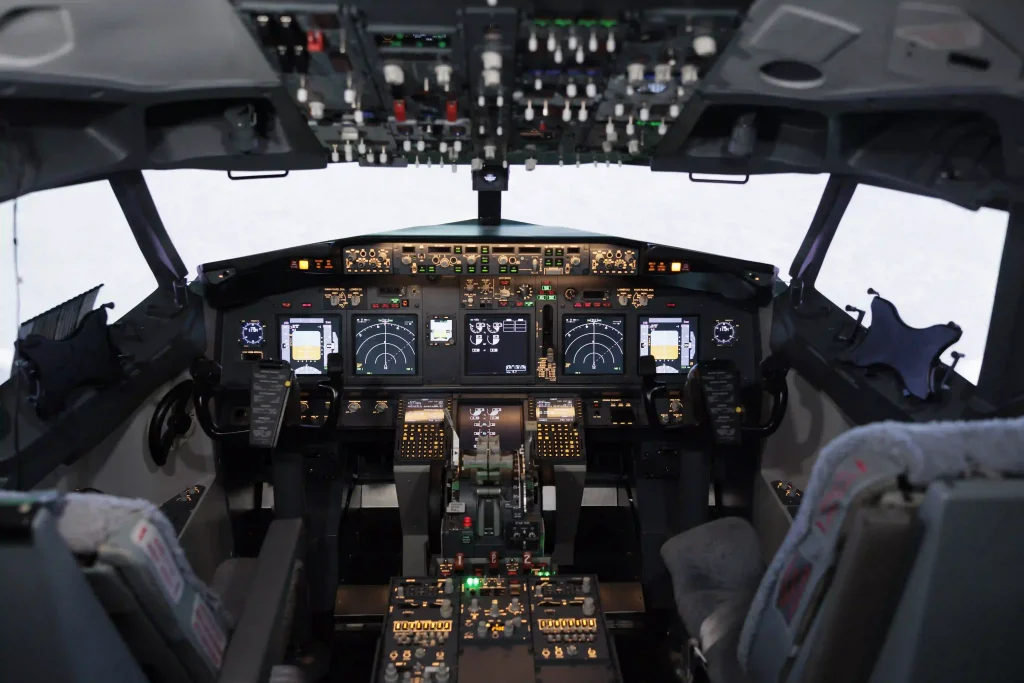
Imagine experiencing the adrenaline rush of a sudden engine failure or battling severe wind shear at 30,000 feet. You are forced to make split-second, life-saving decisions, all without ever leaving the ground.
This is the incredible reality of modern aviation education. Today, a highly structured pipeline of simulation technology that ranging from foundational Advanced Aviation Training Devices (AATDs) to multi-million-dollar Level D Full Flight Simulators (FFS) which has fundamentally revolutionized how commercial pilots are forged.
In this article, we will explore how this spectrum of hyper-realistic systems seamlessly bridges the gap between traditional classroom theory and real-world cockpit experience. From the critical early stages of mastering basic airmanship to executing high-stakes emergency scenarios in a zero-risk environment, we will dive into how the right simulator at the exact right time accelerates a cadet’s journey from the training academy directly to a commercial airline seat.
What Makes a Full Flight Simulator Different?
At the pinnacle of modern aviation training is the Level D FFS simulator, a technological marvel that completely blurs the line between digital recreation and physical reality. These highly advanced machines are engineered with exacting precision, featuring a true 1:1 replica of a specific aircraft cockpit down to the exact placement, texture, and functionality of every single switch, gauge, and flight management system.
Encased within a massive dome, wrap-around high-definition visual systems project hyper-realistic environments, dynamically rendering everything from severe thunderstorms to complex airport taxiways. Supporting this visual spectacle is a sophisticated six-axis motion platform that heaves, pitches, and rolls in perfect, instantaneous synchronization with the pilot’s inputs.
To truly understand the value of an FFS, one must contrast it with basic Flight Training Devices (FTDs) or legacy desktop simulators. While traditional FTDs and fixed-base simulators are excellent tools for procedural practice and basic instrument scanning, they lack the visceral because all-encompassing environment required to induce genuine psychological immersion.
A desktop setup might teach a student how to execute a standard operating procedure, but it cannot replicate the physiological stress of a dark, turbulent cockpit during an in-flight emergency. The multi-million-dollar Level D simulator strips away the safety net of a quiet classroom, enveloping the trainee in a high-stakes psychological state where the mind fully accepts the gravity and pressure of the flight.
This profound level of psychological immersion is ultimately driven by the simulator’s mastery of precise sensory feedback. When a cadet pushes the throttles forward for take-off, they do not just watch the digital runway accelerate; they feel the deep, resonant vibrations of the engines and the gravitational forces pressing them back into their seats.
The physical resistance of the controls such as the dynamic feedback of an Airbus sidestick changes organically based on airspeed and aerodynamic loads, effectively tricking the brain into treating the simulation as absolute reality. By engaging all the senses simultaneously, the FFS moves beyond mere intellectual learning; it aggressively solidifies the physical muscle memory, instinctive reaction times, and critical decision-making skills that will one day ensure passenger safety in the real world.
Zero-Risk Emergency Training
There is an undeniable truth in commercial aviation: you cannot safely practice a catastrophe in the sky. To intentionally induce a dual engine flameout, trigger a cascading hydraulic failure, or steer a multi-ton aircraft into extreme, violent weather events like microbursts simply to test a pilot’s mettle is unthinkable. In actual airborne training, strict safety margins must always be maintained, which fundamentally limits the severity of the emergencies a student can physically experience.
Consequently, relying solely on real-world flight hours leaves a critical vulnerability in a pilot’s education, as they cannot safely experience the sheer terror and mechanical degradation of a worst-case scenario where the safety net is completely removed.
This is precisely where the Full Flight Simulator demonstrates its most indispensable value, providing a zero-risk arena for the unthinkable. From the safety of an advanced instructor operating station, flight educators can dynamically inject a limitless array of mechanical faults and environmental hazards into a session without a moment’s notice.
A serene cruise at 36,000 feet can instantly transform into a high-workload crisis as a simulated cargo fire erupts, or a routine final approach can be violently upended by sudden wind shear and an avionics blackout. This deliberate orchestration forces cadets into a state of extreme task saturation, demanding that they manage complex emergency checklists, coordinate with air traffic control, and ultimately keep the aircraft flying.
Accelerating the Path to the Right Seat
One of the most powerful learning accelerators provided by a Full Flight Simulator is the manipulation of time itself. In a physical aircraft, an error made during a complex instrument approach requires a lengthy go-around, burning precious fuel and training minutes just to reposition the aircraft and attempt the maneuver again. In the digital environment, however, instructors possess the invaluable tool of “frozen time.”
They can instantly pause a flight at the exact moment a cadet makes a miscalculation, deeply analyze the mistake using real-time data, and seamlessly rewind the scenario to practice the maneuver again until absolute perfection is achieved.
Furthermore, simulators offer unparalleled logistical freedom by operating independently of the outside world, 24 hours a day, 7 days a week. A cadet’s progression is never derailed by unpredictable adverse weather conditions, unexpected airspace closures, or lengthy air traffic control holds, ensuring a highly concentrated and uninterrupted learning curve.
Because of the exacting realism and rigorous certification standards of modern FFS technology, global aviation authorities legally recognize these highly targeted simulator sessions as genuine, recorded flight hours. This creates a profound efficiency in a pilot’s education. Rather than spending months waiting for clear skies or flying empty transit legs just to reach a practice area, cadets spend every minute of their simulator time actively honing critical operational skills.
Ultimately, this high-density training environment does more than just save time and money; it ensures that a cadet can transition seamlessly and safely from the academy directly into the right seat of a commercial airliner, armed with the profound confidence and ingrained muscle memory required of a professional first officer.
The Economics and Ecology of Premium Training
Beyond the obvious safety constraints, there is a harsh economic reality to aviation education: operating a commercial airliner is staggeringly expensive. If an academy were to rely solely on actual aircraft for advanced procedural or type-rating training, the logistical costs would be astronomical. Every single hour spent in the sky burns through hundreds of gallons of premium Jet-A fuel, racks up steep airport landing and approach fees, and accelerates the need for highly specialized, routine mechanical maintenance.
When you factor in airspace restrictions and the immense wear-and-tear placed on a multi-million-dollar airframe during repetitive training maneuvers, using a real jet as an everyday classroom is a financial model that is fundamentally unsustainable.
Full Flight Simulators disrupt this traditional cost equation, drastically reducing the financial barrier to entry for both flight schools and their prospective cadets. While the initial capital investment to acquire a state-of-the-art Level D simulator is substantial, the ongoing hourly operating cost is a mere fraction of flying a physical airliner. This crucial paradigm shift allows premier training academies to offer their students far more comprehensive training hours, extended scenario-based sessions, and repetitive practice without exponentially inflating tuition fees.
Consequently, cadets can comfortably log the extensive “seat time” necessary to achieve absolute mastery over complex flight management systems, making top-tier airline preparation more accessible and economically viable than ever before.
Furthermore, this economic efficiency aligns perfectly with an often-overlooked yet increasingly critical advantage: the profound environmental benefit of simulated flight. As the global aviation industry aggressively pursues sustainability targets, training footprints are under heavy scrutiny.
By shifting hundreds of intensive training hours per cadet from the active runway to a localized, electric-powered simulator, academies are effectively grounding thousands of gallons of aviation fuel that would otherwise be combusted into the atmosphere. This translates to a massive, quantifiable reduction in both carbon emissions and community noise pollution. Ultimately, the modern simulator does not just prepare the next generation of pilots to safely navigate the skies; it plays a vital, active role in ensuring those skies remain cleaner for the future.
Forging the Future: From First Flight to the Flight Deck
Ultimately, advanced simulation technology is no longer just a supplementary training aid. It already become the foundational backbone of modern aviation education. As we have explored, top-tier simulators provide an unmatched environment for mastering complex aircraft systems, executing zero-risk emergency procedures, and optimizing flight economics at the highest levels of commercial aviation.
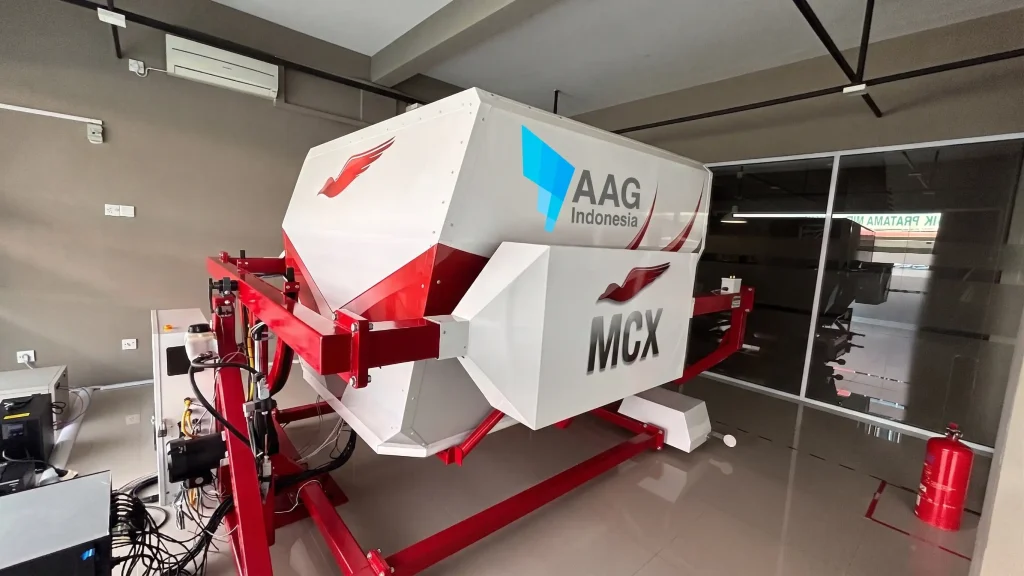
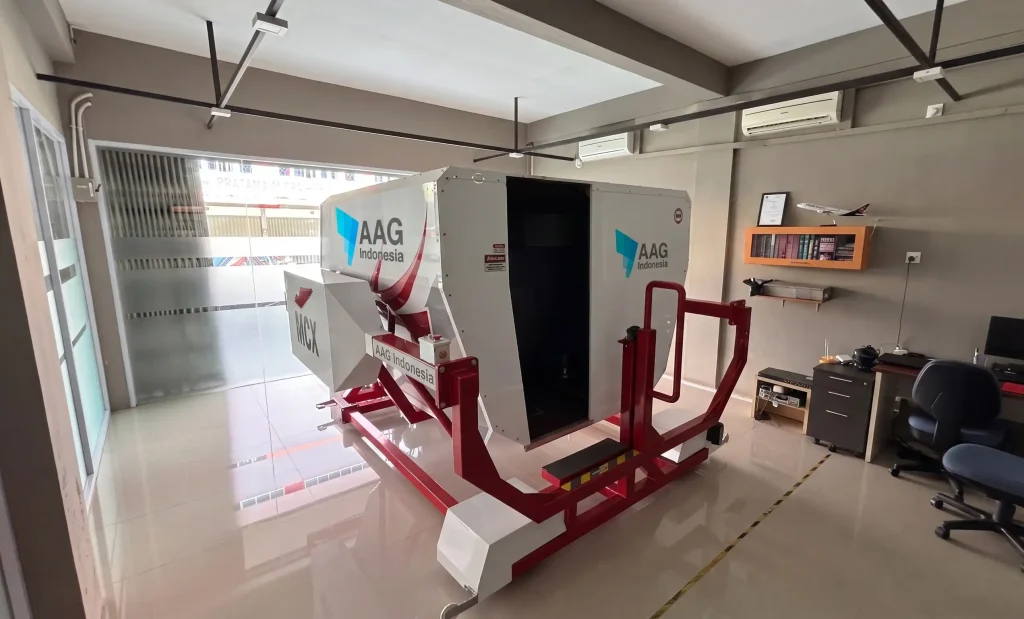
However, long before a cadet ever steps into a multi-million-dollar Airbus or Boeing Level D Full Flight Simulator, they must first build a rock-solid foundation in basic airmanship. At AAG Indonesia, we recognize our specific and crucial role in this journey. While our Batam academy does not house Level D FFS technology, we have deliberately invested in Redbird MCX full-motion simulator. We are humble about our scope but exceptionally confident in our methods: the Redbird MCX is the perfect technological stepping stone for early-stage aviators.
Though different in scale from an airline-grade FFS, it delivers the precise aerodynamic feedback, rigorous instrument scanning practice, and foundational emergency scenarios that ab-initio cadets absolutely require. It ensures our students develop unshakeable confidence and procedural discipline before they ever take the controls of an actual Cessna or Piper.
The aviators of tomorrow like you aren’t just forged in the sky, they are perfected on the ground through the crucible of realistic, targeted simulation, ensuring that when they finally transition to an airline training program, they are ready for anything.
Ready to start your journey to become a pilot? Discover how AAG Indonesia integrates advanced Redbird MCX simulator hours into our comprehensive Airline Pilot Pathway Program (APP), and take the first step toward your commercial pilot career today.
Contact our admissions team today at id.info@aag.aero or reach out to us at +6281196955717 to learn more about our upcoming intakes at our Batam headquarters. Take the first definitive step toward your aviation career today—your captain’s seat is waiting.